
A message sequence is a reusable set of follow-up messages that go out step by step — reminders, check-ins, nudges — each with its own timing and conditions. Where a blasting is one broadcast to many people at once, a sequence follows up with one customer over time, automatically.
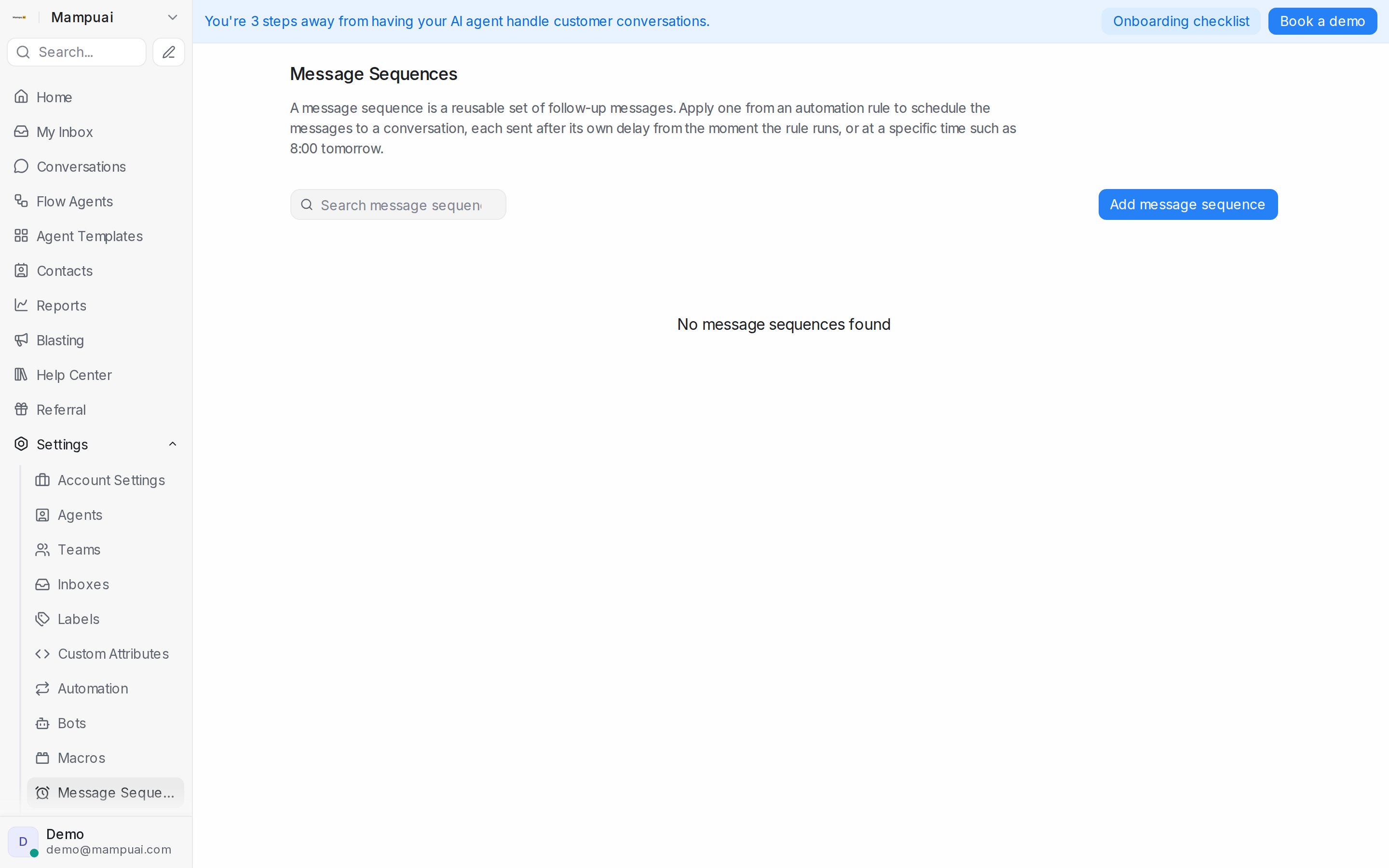
Open Settings → Message Sequences and click Add message sequence.
Watch the walkthrough
Triggers — when a sequence starts
- Manual — applied by your automation rules (e.g. when a conversation gets a certain label) or by inbound webhooks.
- Inactivity — starts when a conversation handled by the selected flow agents goes quiet.
- Appointment booked — starts when a booking lands on one of your calendars, so you can send confirmations, reminders before the appointment, and follow-ups after it.
Steps — what goes out, and when
Each step holds one or more messages (with media attachments if you like) and its own timing:
- After a delay — e.g. 2 days after the sequence starts.
- At a specific time — e.g. 8:00 tomorrow.
- Around a date — before or after a contact date attribute, or the appointment time for booking-triggered sequences (at booking, before the appointment, after the appointment).
Only send if…
Every step can carry conditions, checked right before that message goes out — conversation language, current date, and more. If the conversation doesn’t match, that message is skipped and the rest of the sequence continues.
WhatsApp’s 24-hour window
If a step may deliver outside WhatsApp’s 24-hour reply window, attach an approved WhatsApp template to the step and map its variables — the sequence automatically uses the template when the window is closed, so the message still arrives.
You can also control repeats with Allow again after — how many days must pass before the same message can be sent to the same conversation again.
Send in each customer’s language
A sequence can carry a version of every message in each language your AI persona speaks. Customers receive the version that matches the language they chat in; everyone else receives the default language.
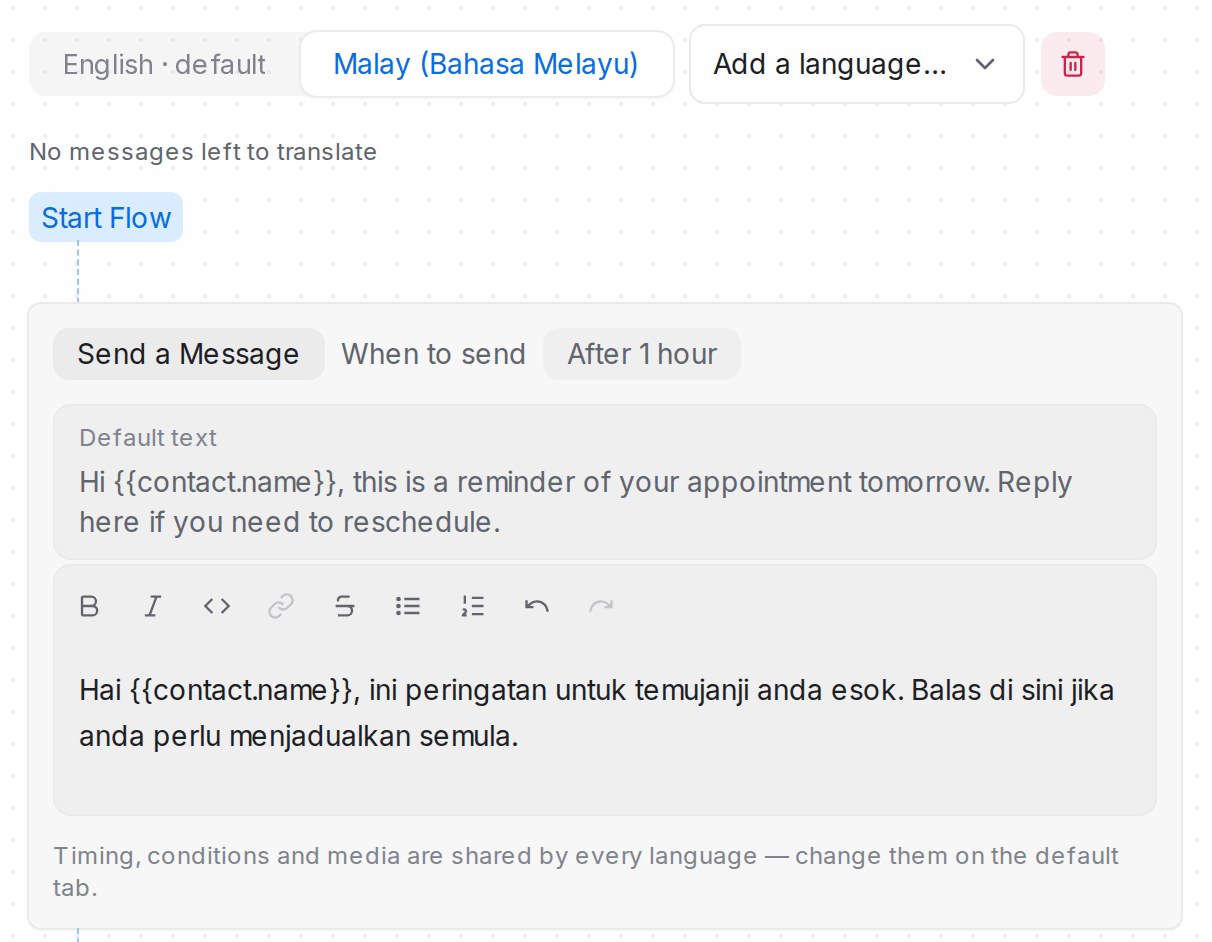
- Write the sequence in your default language as usual.
- Above the steps, pick a language from Add a language…. The list mirrors the languages in your AI persona settings (Flow Agents → AI Knowledge → Tone & persona).
- On the new language tab, each message shows the default text as a reference with an editor beneath it — write that language’s version there. Timing, conditions, media and the message list are shared, so you change them on the default tab.
- If a step has a WhatsApp template, pick that language’s template too with Pick a … template; until you do, the default template is used.
A message you leave blank in a version simply sends the default text, and the tab shows how many messages are still untranslated. In Setup → Language, choose the Default language — the one everyone else receives. Once a version is fully translated you can make it the default, which swaps it with the current default message by message. Remove a version with the trash icon next to its tab.
If a language is later removed from your AI persona settings, its tab shows inactive: the text is kept, but customers won’t receive it until the language is added back.
Duplicate a sequence
Need a variation of a sequence you already have — new wording, a second audience, a seasonal version? On Settings → Message Sequences, click the duplicate icon on the sequence’s row. You get a new sequence named “… (Copy)” with every step, timing, condition, and setting carried over.
The copy never sends anything on its own: it keeps the trigger type, but you choose the flow agents or calendars again before it goes live — so duplicating a live sequence never causes double sends. Edit what you need, pick the targets, and save.
Related
- Managing AI Knowledge — the Tone & persona languages a sequence can be translated into.