
Every new conversation in an inbox that has agents is handed to one of them as soon as it arrives, so nothing sits unowned while your team is away. You manage this in two places: the switch on each inbox’s Collaborators tab, and Settings → Agent Assignment, where policies fine-tune who is eligible and how the work is shared.
How assignment works out of the box
With no policy in place an inbox follows the default rules, listed on its Collaborators tab under Conversation Assignment:
- Earliest created conversations first — the conversation that has waited longest is handed out first.
- Round robin distribution — the agents added to the inbox take turns.
- Every inbox member, online or offline — an agent does not need the dashboard open to receive a conversation. If you would rather hand conversations only to agents who are online, use a policy (see below).
Only conversations with activity in the last hour are handed out. A conversation that has been waiting longer stays as it is until the customer writes again, so switching assignment on never floods your team with old chats.
Each assignment is recorded in the conversation as an activity line such as Assigned to Aisyah by Default Policy, and the agent is notified as usual.
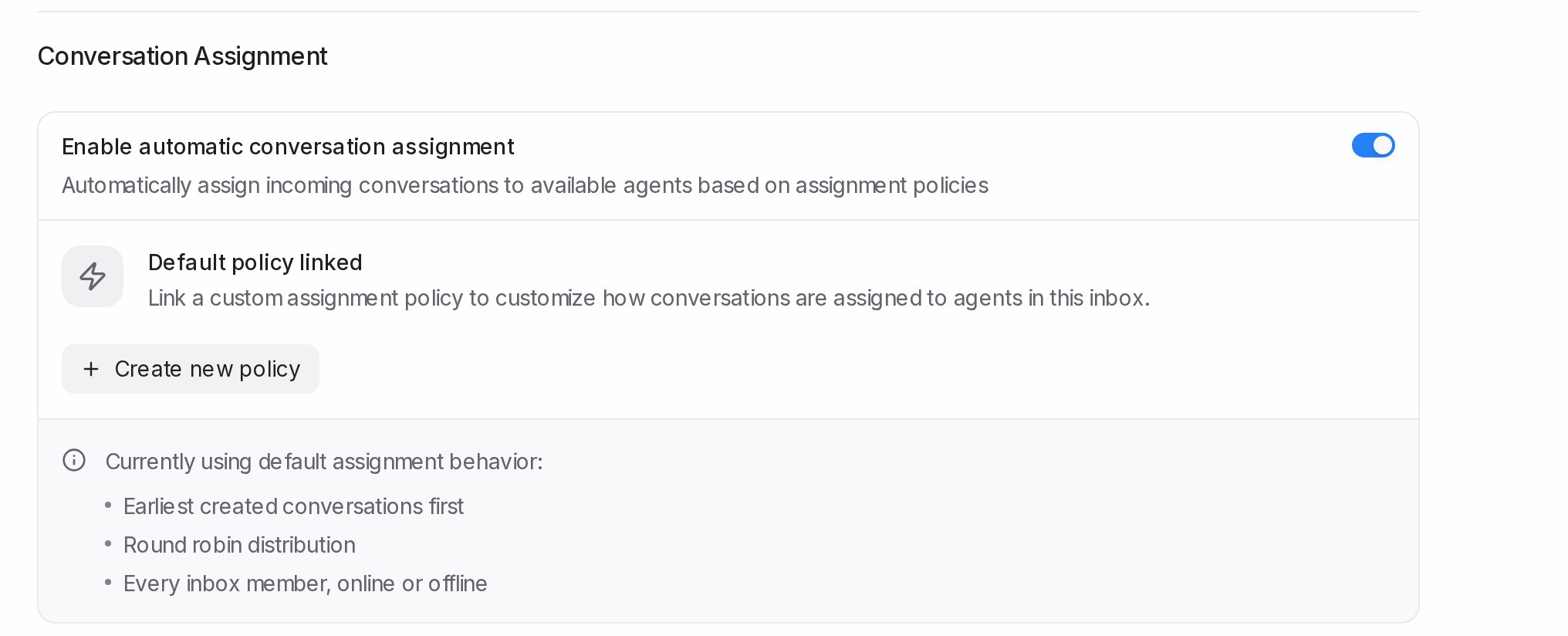
Turning automatic assignment on or off for an inbox
- Open Settings → Inboxes, choose the inbox and open the Collaborators tab.
- Under Conversation Assignment, use the Enable automatic conversation assignment switch. It is on for every new inbox.
- With the switch off, new conversations stay unassigned until someone picks them up, as described in Assigning conversations to agents and teams.
Only the agents listed under Agents on the same tab, and members of teams the inbox has been shared with, receive conversations.
Assignment policies
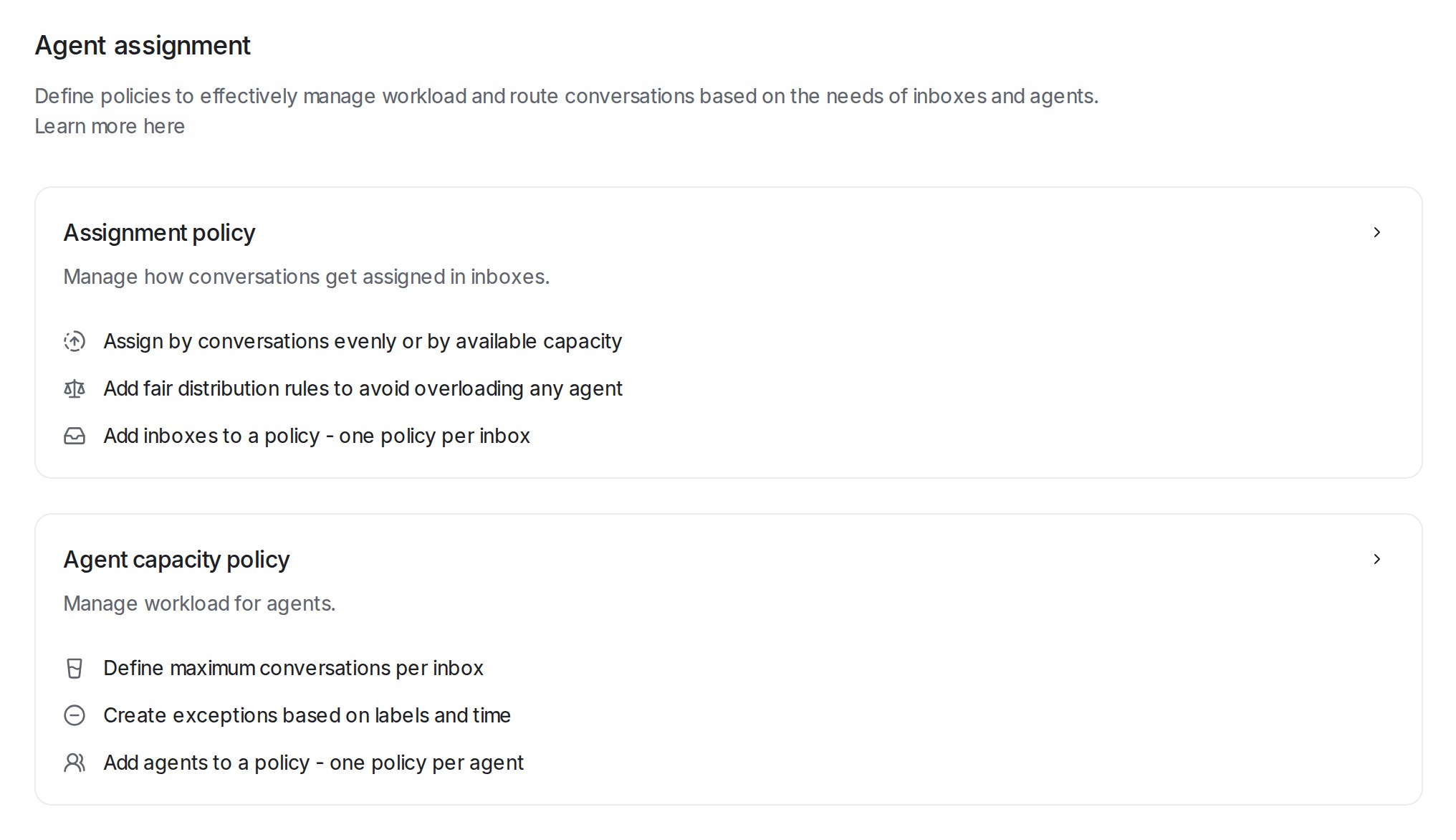
A policy replaces the default rules for the inboxes you link it to. Open Settings → Agent Assignment, choose Assignment policy and click New policy.
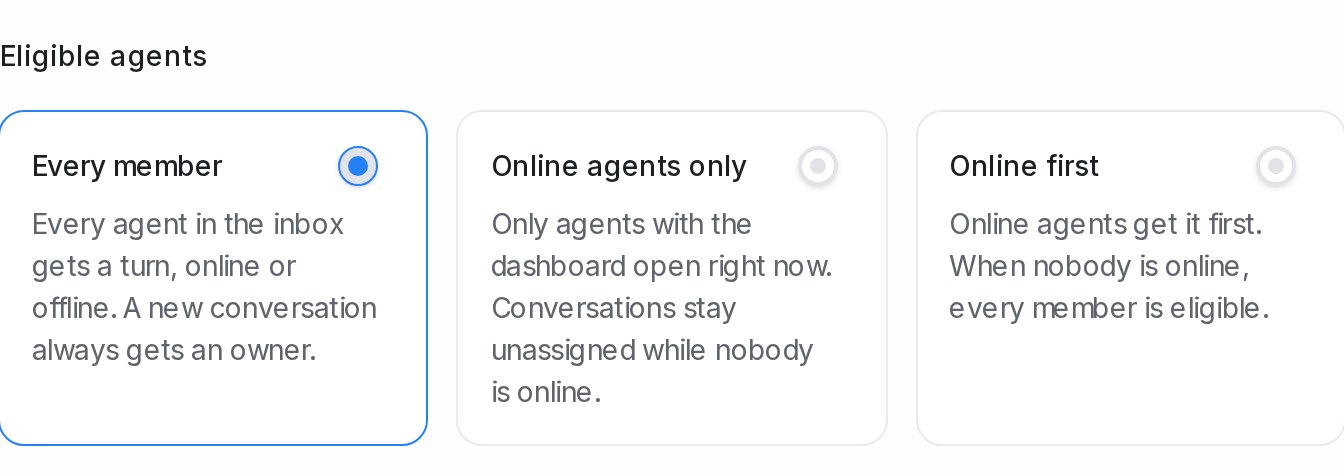
- Eligible agents decides who may receive a conversation:
- Every member — every agent in the inbox gets a turn, online or offline. A new conversation always gets an owner.
- Online agents only — only agents who have the dashboard open right now. Conversations stay unassigned while nobody is online.
- Online first — online agents get it first. When nobody is online, every member is eligible.
- Assignment order — Round robin shares conversations in turn; Balanced gives each conversation to the agent with the fewest open conversations in that inbox.
- Assignment priority — Earliest created or Longest waiting decides which waiting conversation is handed out first.
- Fair distribution policy — caps how many conversations one agent receives in a time window, for example 100 per hour. Without a policy there is no cap.
- Skip stale conversations — conversations with no activity beyond this age are left alone. A new policy starts at 1 hour. Raise it when you want an older backlog handed out; clear it to hand out every unassigned conversation.
Click Create policy, then add inboxes under Added inboxes with Add inbox. You can also link a policy from an inbox’s Collaborators tab with Link existing policy, and remove it there with the bin icon, after which the inbox returns to the default rules. An inbox carries one policy at a time.
Agent capacity policies
Settings → Agent Assignment → Agent capacity policy limits how many open conversations an agent holds in an inbox at once. Create a policy, add the agents it applies to and set a conversation limit for each inbox. An agent at their limit is skipped until they resolve something, and the conversation waits for the next available agent. Exclusions keep conversations with certain labels, or older than a given age, out of automatic assignment altogether.